
The Path, The Road
On Wandering

I’m fortunate to have the chance to spend some of my summer in a New Jersey beach town, right on the bay where the sunset bursts through the windows and turns the inside of the house all of the beautiful red, orange, and yellow hues that settle the nerves before bed. This beach town is an interesting combination of personalities. Amongst the slow-moving beach goers moseying around and enjoying opportunities to relax, there are those who are determined to extract every moment of ‘relaxation’ from their trip, moving from point to point with speed and intensity, ensuring they get from point A to B efficiently and on time. Admittedly, I’ve been both of these people. I’ve slowly ridden my bike to the bakery to bring home some donuts and I’ve driven a little too quickly down Ocean Drive to get to the pizza shop and back in time so as to not mess up everyone’s bed time routines.
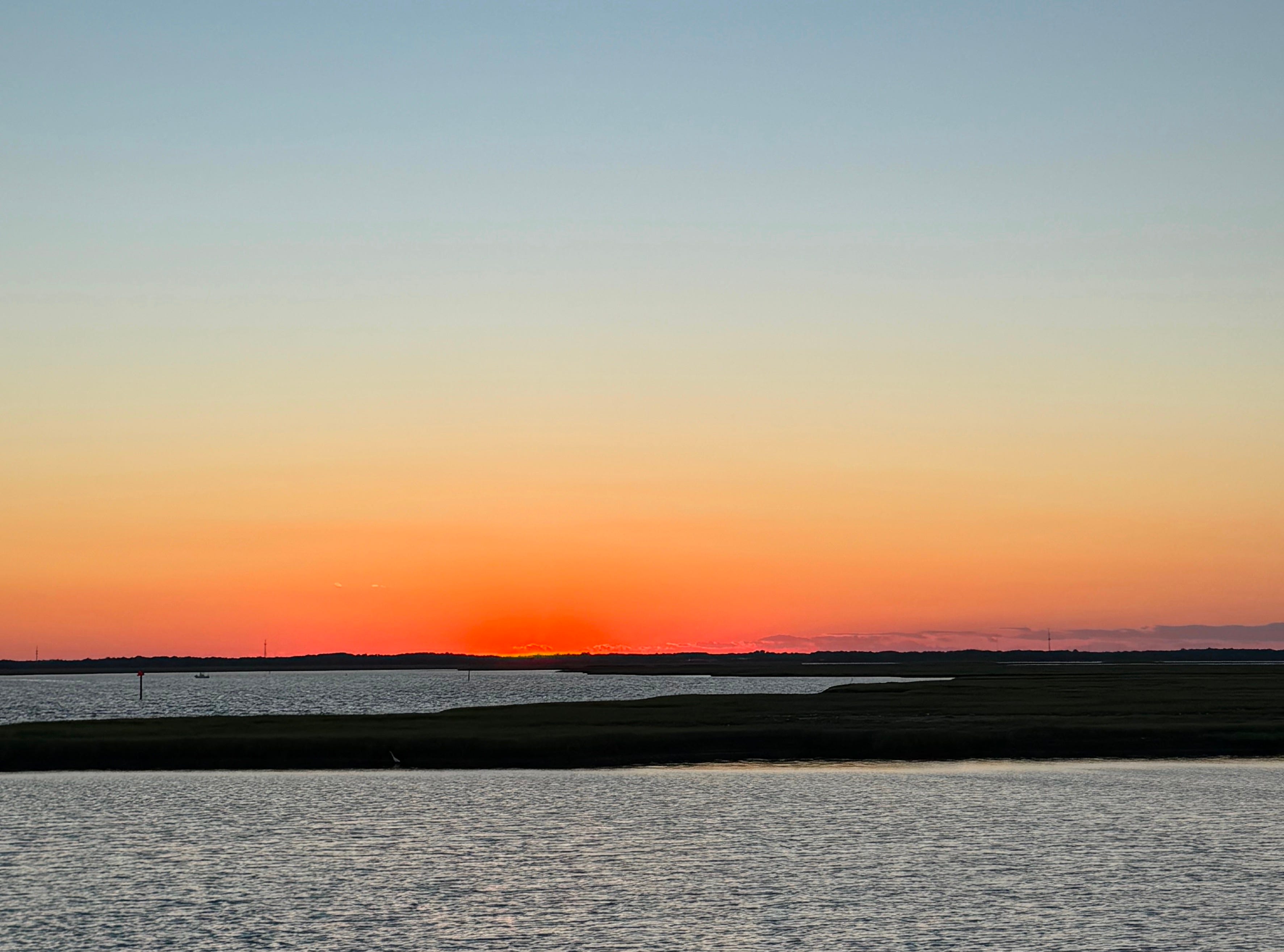
Last week I took my kids to get ice cream and, instead of driving straight home to wash their sticky hands and mouths, we took a lap around the town seeing the sunset from the north end and the south end, watching the slow walkers and speedy bicyclists move alongside our car. I didn’t actually say anything to the kids about it, and my oldest was veryconfused – why aren’t we going home? “Sometimes it’s just nice to see what’s going on, right?” I told her. She sat back and turned toward the window.
The Path, The Road
Otto Bollnow makes a distinction in Human Space that we have two kinds of spatial structure – the path and the road.
The path is old. Older than we are. Bollnow points out that when we enter an unfamiliar space, we don’t create a spatial structure from scratch, but we inherit it. We follow “the beaten paths of hippopotamus and elephant.” The path, in this case, is a gift from the more-than-human world, worn into the earth by the bodies that came before ours. It winds because the terrain winds, it bends because a stream is there, because the ground rises, because something is growing and blocking the way, forcing us to walk around it. Paths are not designed but received and then worn further by wandering through them.
A road is something else entirely. Bollnow tells us the road is where we stop following and start building. It “varies according to the state of technology.” It widens, straightens, and hardens and, in this, Bollnow says “man emerges as ruler of nature.” The road is human exceptionalism. It cuts through the landscape rather than moving with it. It levels terrain and moves obstacles, always with the goal of making the most efficient line between point A and B. In so doing, it ignores the world.
A Subject Amongst Subjects
Bollnow goes on to describe the wanderer – the person who walks the winding path. It’s a beautiful phenomenological metaphor and my favorite in the book. Wandering, he says, “flows irregularly like a stream over the uneven river bed.” The wanderer is “no longer separate from the countryside… but he actually wanders through the countryside, becomes a part of it, is completely taken up by it.”
The key is absorption. The irregularity of wandering is what allows you to be absorbed into the place rather than cutting through it. The bending, pausing, flowing, and following forces you to move with the world. On the path, you become a subject amongst subjects. You are with the landscape, part of its ongoing life. On the road, you are subject amongst objects. The landscape is scenery passing by the window. You are separate from it, moving through it and toward some final destination.
Our world is so attuned to the road at this point, that you get reactions like my oldest’s – “Why aren’t we going home?” Wandering was so foreign, it produced confusion.
And yes, this is all obvious metaphor, but it is so clear in Human Space that the journey “is not some temporary or occasional resting-place, but describes a basic situation, perhaps the basic situation of man in the world.” We are fundamentally homo viator – wayfarers. The journey is the ontological act of becoming. It is through the many winds and turns, the many stumbles and peaks, the many uphill scrambles and gentle flat prairies that we become who are. We are always on our way to becoming, on an lifelong path toward being.
This makes the question of how we move an ontological one. The structure of our movement shapes who we are becoming. If we live a life of roads – straight, simple, quick, efficient, and abstracted from the worldly landscape – what do we become? If we live a life of paths – inherited, windy, bumpy, constitutive, and in the world – what do we become? What have we become?
A Holiday Activity
Human Space drives me a little bit nuts because Bollnow contradicts himself quite a few times. After all of that – describing wandering as this beautiful basic situation of human existence – he snaps right back to bourgeois reality. Wandering, he eventually says, “is a holiday occupation, that is, of its nature a temporary release from the serious life of work.” Man wanders, regenerates, and “then return, rejuvenated, to the seriousness of life, in order to fulfill his task there.”
Come on, man.
Going against his own phenomenological insights, his extraordinary analysis of wandering, he tucks it neatly into vacation. Wandering is fine, but only as a short break so you can return to the machine and produce. As long as you return to the road.
This reveals something interesting, though. The fact that wandering needs to be justified as restorative – something that makes you better at road-work – tells you which spatial logic is the default. The road is serious business, the path is what you earn when you’ve done enough road time. A wanderer’s absorption into the world, the beautiful entanglement described earlier, is simply recreation.
GPS Logic
The spatial logic of the road permeates all aspects of our lived experience but, as I am most interested in doing, I will speak of it in education. The GPS guided route that points you down the road from point A to point B is the same logic we use in teaching.
The teacher’s GPS these days is standards, scope-and-sequence plans, curriculum maps, credit hours, learning objectives, rubrics, and pacing guides. They are the infrastructure of the road. They engineer the most efficient line between two points with the destination identified in advance and the timeline fixed. The terrain is leveled and paved so that nothing slows the learner down and, if a student starts to wander off-road, they are off task and falling behind.
Bollnow’s language gives us a way to think about this. Remember what he says about the path – it is inherited, worn in by creatures before us. The road is where “man emerges as ruler of nature.” The road, in education, it where the institution emerges as ruler of the learning. The student is not allowed to inherit a path that has been laid down before them, by their situatedness in the world, by their sedimented histories, by their bodily orientation. They are placed on a road and sent toward a predetermined end.
That learner is a subject amongst objects, surrounded by content and standards and curriculum but not at all entangled in it. Just passing through.
Wandering as Method
I find myself wandering all the time. My body is constantly wandering, feeling every step of the path with my bare feet and every hill climb with an aching back and sore legs. I wander, slowly, through the joy of my kids playing in the ocean. I wander, slowly, when I share in my wife’s pain through the comingling consciousness of marriage. At least, I try to. I try to absorb myself in it, to feel my way through it, because I know that around the next bend will be a different version of me, with new meaning and new understanding. I know that around that next bend, my kids and my wife will have new meanings and understandings as well, and isn’t it nice that, no matter the path, we are wandering together?
Bollnow says: “Only a being that… is torn through the deep shocks of nothingness… out of the natural security of the familiar connections of life… is capable of hearing the voice of the distance.” It is only when we are snapped back from the abstraction of the road to the inefficient contexts of the path are we able to “hear the voice of the distance” – to be beckoned toward becoming.
There’s a critical argument to be made here that wandering is aimless, but I don’t think the path is the absence of direction. A path goes somewhere, but the direction is responsive – it bends when the terrain bends, when the situation changes. It follows what is actually there rather than imposing a line over it.
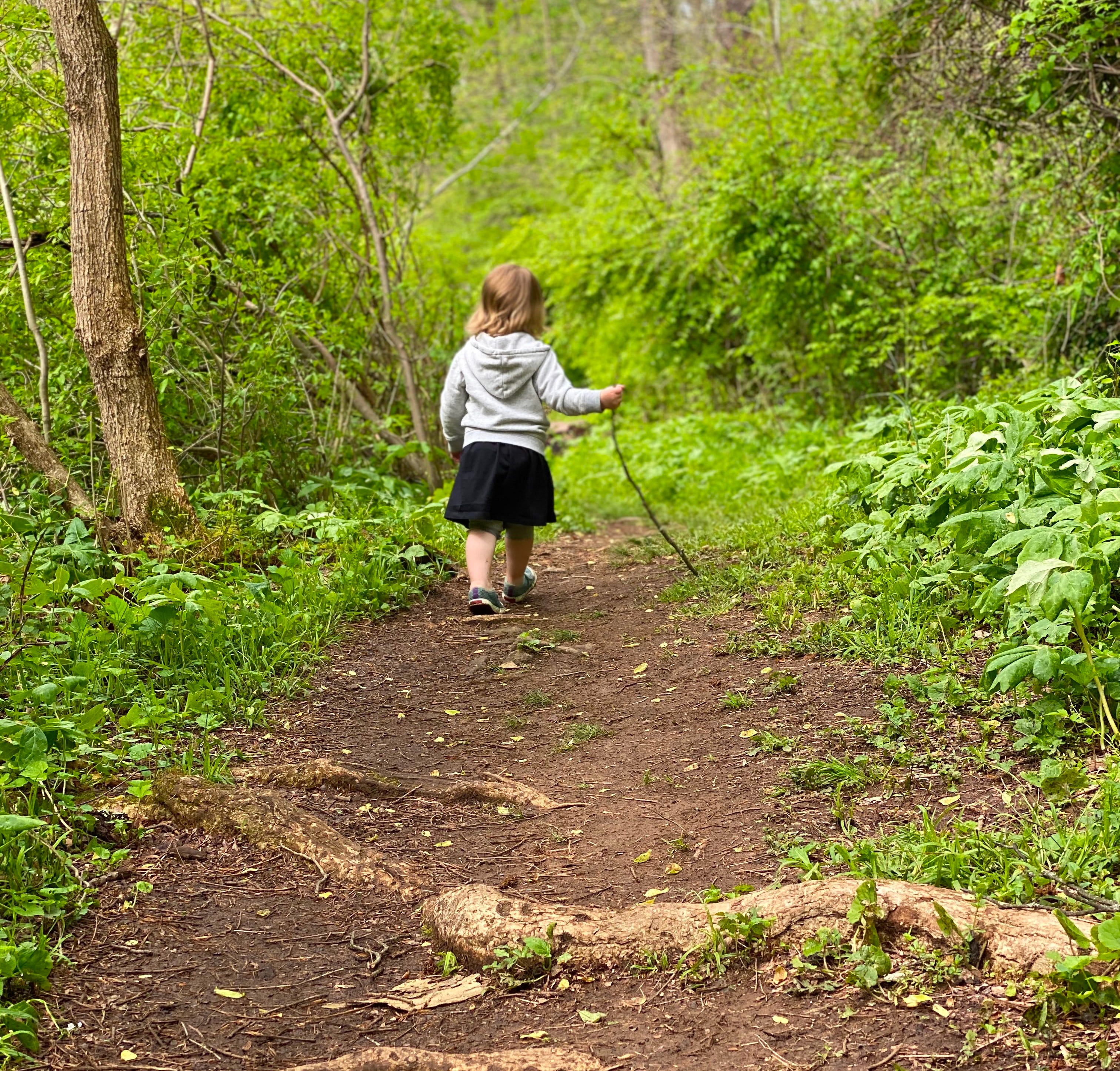
What might it look like to take wandering seriously? To think of it as the work rather than the vacation? To wander through a question rather than engineering a road to an answer? To let research follow the terrain of what shows up rather than executing a plan? To write the way you walk a path? To follow the sentence, pausing when something appears beside you and letting the next thought arrive?
Michel Serres, in The Five Senses, describes what I sometimes call my dream methodology for writing and research:
“Let us design an interesting itinerary, one that leaves it optimal talweg and begins to explore a place: one which does not reach a foreseeable resolution, but searches; seems to wander; not deliberate or sure of itself, but rather anxious, off balance and relentless; questing, on the watch, it moves over the whole space, probes, checks things out, reconnoitres, beats about the bush, skips all over the place; few things in the space escape its sweep; whoever follows or invents this itinerary runs the risk of losing everything or inventing; if he makes discoveries, it will be said of his route that he has left the talweg to follow strange attractors.”
Let’s all follow strange attractors.