
Leave No Trace
A Ghost in the Woods

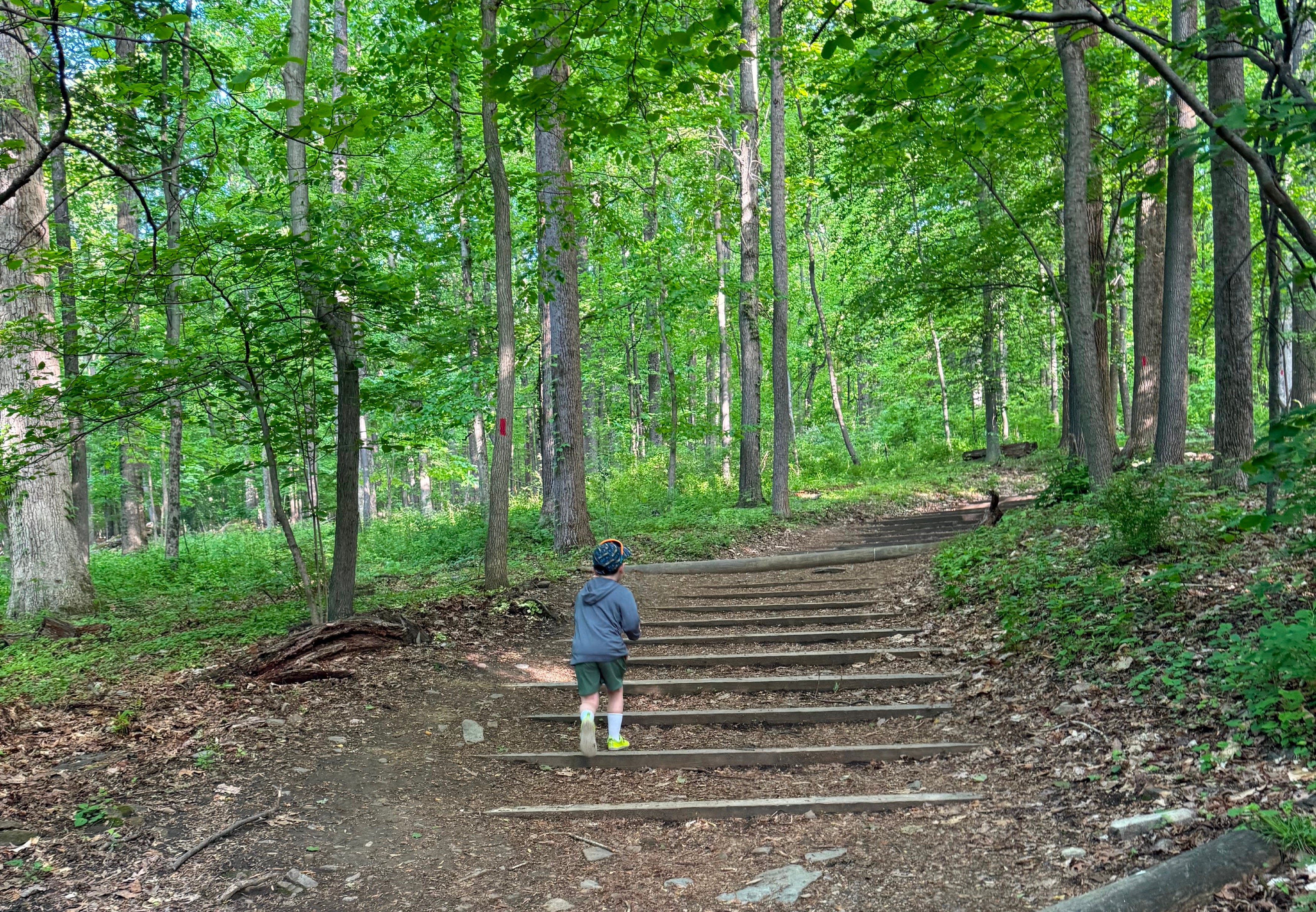
As the weather (finally) turns, I’ve been able to take my kids out on trails again without complaints. Typically we end up in nearby Valley Forge and go up and down the “mountains” (read: large hills) there and along the creek, occasionally dipping our toes in. Each trail head is marked with a wooden board asking us to remember sunscreen and bug spray, to stay on the trail, and to enjoy the deep breaths the beech trees provide. On the board is also the reminder to “Leave No Trace” along with its seven principles which are perhaps obvious if you spend time outdoors. Plan ahead, travel on durable surfaces, dispose of waste properly, leave what you find, minimize campfire impacts, respect wildlife, and be considerate of others. Meanwhile, my foot presses into the dirt below my feet.
Listen. I’m not a dummy. I’m not on the trail throwing snack wrappers around like confetti, I’m not chasing ovenbirds and trying to stomp their nests that surround the forest floor. Leave No Trace is a good ethic and I want to make sure I say that plainly before I start tugging on this thread. The impulse behind Leave No Trace is care – care for the place that you are in and the human and other-than-human lives you are sharing it with.
Ok, now think through this phrase slowly and maybe it’ll hit you like it hit me last week when I was on Mount Misery (great name, right?) with my 5 year old. It’s kind of strange, right? It’s asking me to move through a place as though I can be in it without being a part of it. As though some version of me can pass through the woods like a ghost and the woods close back up behind me, unmarked, as if I never happened. That version of me doesn’t exist. There is no way to be in a place without being fully entangled in that place, actively gesturing toward and being gestured toward all of the things around us.
There Is No Outside
I’ve tugged on this thread before – including in my rant about how silly grades are. The view from nowhere. The idea that there is some place to stand outside the world from which you could observe it cleanly, without your own body and your own sedimented histories getting in the way. Without the world and its history pulling back on you.
We often assume there is. We picture a way of knowing that floats free of any particular body, any particular place, and particular history – a kind of knowing that sees the whole thing from above and reports back. “Clean data.” This objective account tells us about a world as it is when no one is looking. A complete vacuum. No entanglement, no interaction.
Merleau-Ponty spends the Phenomenology of Perception showing that this account is a fiction. It’s a useful one at times, sure, but a fiction nonetheless. Everything I know, he says, even the things I know through science, I know from a perspective that is my own. Every piece of knowledge I have comes to me from somewhere: from a body that is here and not there, from eyes at this height, from a history that brings me to this place, full of sedimented knowledge and understandings. There is no such thing as an inner self, sealed off from that. There is no quiet chamber where truth sits apart from the world. As Merleau-Ponty puts it, “man is in and toward the world.” I don’t look at the world across a gap. I am in it and of it, turned toward it always. The world is not an object I can hold at arm’s length. It is the field every one of my thoughts is already standing in. I am entangled in it.
The Fantasy of Zero
Let’s go back to the trailhead and take a peek at the sign. Leave No Trace. Have Zero Impact. What does that assume?
It assumes off the bat that impact is the kind of thing that could, in principle, reach zero. That we have an ability to turn our presence down a few notches until the place is genuinely untouched by you. That assumption can only hold true if you picture yourself the way the view from nowhere pictures the knower, as someone who is in a place without actually entering into it. A kind of self that hovers above the trail rather than walking it, a ghost.
But you are not a ghost (I hope). When you walk the trail you press into the soil, your presence alerts the w
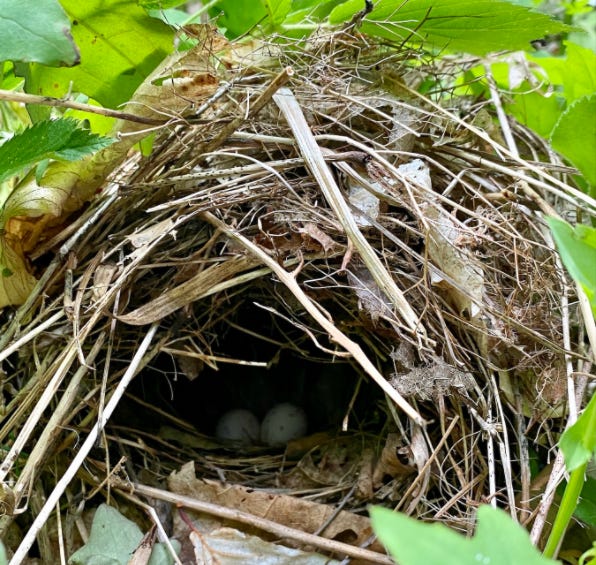
arblers, your breath shakes the beautifully woven moth tent. Your 5 year old’s questions cause you to notice what you might not have before, stopping to stare at a millipede wiggle over a stone. The path itself is a trace, your movement through it – a trace.
You can’t leave no trace. To be in a place is to be entangled in it, to mark it. Not because you are careless but because you were there. You are with it. In it.
Traced Back
You know, we never ask the woods to leave no trace, do we? It’s impossible. Just as we leave a trace, we are traced back. Every step in the soil is the soil pushing back on me. The chill of the breeze changes how I hold hands with my son. The light through the trees changes my attention. Hours later, the place is still in you. In your tired legs, yes, but also in the joy of the day. At night when my son says “Thank you for taking me on a nature walk today, Daddy,” that is the trail speaking through him.
This is entanglement – a version of the reciprocity Merleau-Ponty talks about. To touch something is to be touched by it. To perceive a place is to be perceptually shaped by it. You don’t come back from the woods as the same person who walked in. The place sediments into our bodies, becomes part of our being. Part of the pre-reflective equipment that we’ll meet the next place with.
The traces run in both directions. I embrace the trail as the trail embraces me. Entangled. You leave a trace, you are traced upon. You are made up of the markings that places have traced on you.
Contamination
It would be easy to read this and think I’ve just told you that you are a contaminant, destroying the place that you are inhabiting, however momentarily. That isn’t it but it does reveal a gap I’d like to step inside for a moment.
Leave No Trace treats your entanglement with a place as a failure. A mess to be kept as small as possible. And that’s partly right. Stomping on unfolding young ferns and leaving a fire ring full of plastic is brutal. Don’t do that. But we can’t treat a trace as a stain. Entanglement is the condition of our existence, not a failure of it. It is what it means to be-in-the-world, before any sort of ethic gets applied to it. We are always already in communication, in engagement, and in touch with the world around us. A trace is a sign of this, a sign that body and place came into contact and neither one stayed exactly the same afterward.
The Trace Itself
If leaving no trace was never actually on the table – if the fantasy of zero comes apart when you admit that you are in fact an entangled body and not a ghost – then maybe the sign at the trailhead is asking the right thing but in the wrong language. Because it’s true, the stomped fern and trash filled fire ring are not the traces I’m talking about – those are traces that need to go away. Maybe the question was never how to leave no trace, but the question is what kind of trace and when a trace moves from a meaningful mark to a scarring wound.
“Leave no trace” vs “Make your mark” ….